
October 28th, 2021
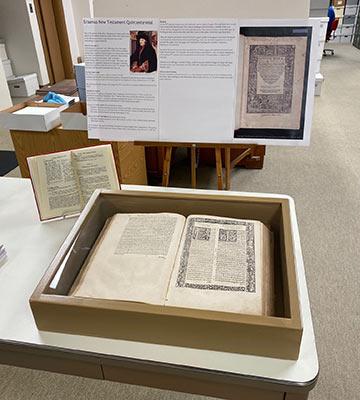
Bethel's Mennonite Library and Archives is trying to get your attention with an invitation to view the oldest book in its collection, which celebrates its 500th birthday in 2022.
The 1522 edition of the New Testament in Greek and Latin, edited by Desiderius Erasmus (1466-1536), is currently displayed prominently upon entering the MLA’s front door, in a case built by Kauffman Museum technician Dave Kreider.
It is currently open to John 1, where students traditionally start when learning New Testament Greek.
The New Testament will be on display for the 2021-22 school year, and archivist John Thiesen plans to turn the pages periodically to different locations in the book so viewers can see more of its features.
Cornelius Krahn (1902-90), a Mennonite historian, scholar and Bethel faculty member, largely responsible for developing the MLA into an important history resource, accessioned the Erasmus New Testament in 1967.
That probably means Krahn bought it in Amsterdam when he was attending the Mennonite World Conference assembly there earlier that year. But little else is known about its provenance.
“It has an annotation of ‘$20’ in Krahn’s handwriting, which would be $163 today,” says Thiesen. “The price was relatively low, probably because the title page is missing.
“The signature ‘O. Kramer’ is inside the front cover, but we have not been able to identify who that was.”
Another feature of this volume is that, as Erasmus’ third edition of the New Testament (the 1516 first edition was the first-ever published Greek translation), it includes the initial appearance of the “Johannine Comma.”
This is a set of trinitarian phrases inserted into I John 5:7-8. Erasmus left them out of earlier editions because he did not find them in early Greek manuscripts.
With the Johannine Comma, the passage reads, in the New Revised Standard Version: “For there are three that bear record [in heaven, the Father, the Word, and the Holy Ghost: and these three are one. (8) And there are three that bear witness in earth,] the Spirit, and the water, and the blood: and these three agree in one.”
Thiesen speculates that by the third edition, Erasmus was feeling pressure from church officials to include reference to “the Trinity” (God the Father, Christ the Son or “Word,” and the Holy Spirit).
William Tyndale used the third edition for the first published English translation of the New Testament, in 1526, as did the translators of the King James Version of the Christian Bible.
The MLA’s book is bound with vellum (calfskin), which Thiesen calls “a middle-of-the-road choice, not the cheapest but not especially fancy.”
In the 16th century, books were sold unbound, as stacks of pages. The purchaser would then have the book bound.
“The owner [of our book] may have chosen this type of binding so they could write titles and other notes on the spine, which this copy does have.
“Also, the original purchaser wrote a good number of marginal notes before the book was bound – or at least before the current binding – since one can find marginal notes cut off around the edges when the pages were trimmed for binding.”
Thiesen hopes the 500-year-old book will bring a few more members of the public into the MLA to see it and get better acquainted with the library.
From 2017-20, Dale Schrag, with support from Bethel’s advancement office, worked successfully to raise a $1 million endowment for the archives.
Now the hope is for success of an unofficial campaign to raise the next million, to assure that the MLA’s historical resources stay protected and accessible for generations to come.
MLA hours during the school year are 1:30-4:30 p.m. Monday and 9:30 a.m.-noon and 1:30-4:30 p.m. Tuesday-Thursday (closed during college breaks). Call 316-284-5304 or visit mla.bethelks.org and use the “Contact Us” link at the top of the page to make an appointment outside regular hours.
Bethel is a four-year liberal arts college founded in 1887 and is the oldest Mennonite college in North America. Known for academic excellence, Bethel ranks at #15 in the Washington Monthly list of “Best Bachelor’s Colleges” and #31 in U.S. News & World Report, Best Regional Colleges Midwest, both for 2021-22. Bethel was the only Kansas college or university selected for the American Association of College & Universities’ 2021 Institute on Truth, Racial Healing and Transformation, and has been named a TRHT Campus Center. For more information, see www.bethelks.edu