
October 4th, 2022
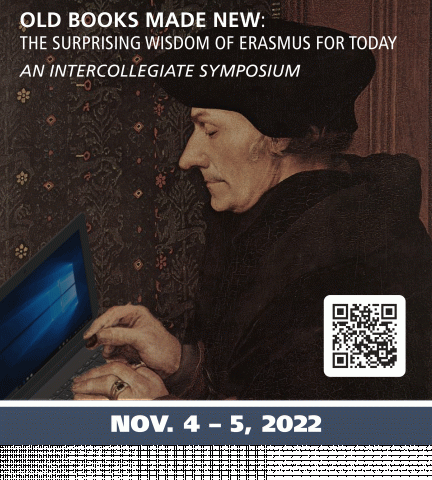
Organized to honor the Mennonite Library and Archives and other libraries, an intercollegiate symposium Nov. 4-5 will look at rare publications of Desiderius Erasmus, along with his current relevance.
When Dale Schrag reached his $1 million fundraising goal for an endowment for the MLA, located at Bethel College, he was ready to celebrate with donors and friends.
Just one problem – the goal completion came in the spring of 2020, when the pandemic was almost literally shutting the world down.
After 2½ years, Schrag says, he wondered if he should just give up the idea of an event.
But a friend with fundraising experience told him, “You have to do something – you can’t meet a major fundraising goal like that without a celebration.”
So Schrag, a retired librarian and church relations director and lifelong historian, and Mary Sprunger, professor of history at Eastern Mennonite University, Harrisonburg, Va., are inviting the Mennonite academic world to a party in honor of Desiderius Erasmus, “the intellectual rockstar of 16th-century Europe,” as Sprunger calls him. (Schrag will also have a private dinner for donors to the MLA endowment in conjunction with the symposium.)
The symposium, titled “Old Books Made New: The Surprising Wisdom of Erasmus for Today,” will be held simultaneously on the Bethel, Conrad Grebel University College, EMU and Goshen (Ind.) College campuses Nov. 4-5, linked via livestream and Zoom.
The symposium is being sponsored by the Marpeck Deans’ Fund, set up by the late Robert and Gerald Kreider to foster inter-Mennonite academic collaboration. There are nine college and seminary members in the United States and Canada.
Other fiscal sponsors are Anabaptist Mennonite Biblical Seminary, Elkhart, Ind., Bethel, EMU and Goshen, which all have Erasmian texts in their libraries, along with Conrad Grebel in Waterloo, Ontario, and a private Kansas foundation, the BISON Foundation.
Bluffton (Ohio) University and Canadian Mennonite University, Winnipeg, will be participating in parts of the symposium.
Schrag is well known as an enthusiastic Erasmus scholar. Erasmus is particularly interesting to Reformation scholars because of his influence on Martin Luther and early Anabaptist leaders.
At a program Schrag did about Erasmus in 2017, he met John Byler from Hesston, Kan.
“He was very interested in Erasmus,” Schrag recalls, “which was unusual for a youngish guy. He had done a master’s thesis [on Erasmus] at Northwestern.”
Byler told Schrag in an e-mail: “We need to do a symposium on Erasmus, because our world needs Erasmus like never before.”
So the seed of an “Erasmus symposium” as a way of honoring the MLA and other libraries had been planted. With the idea of making it intercollegiate, Schrag began working with Sprunger on the planning.
As Schrag was contemplating what to build a symposium around, he thought about the oldest book in the MLA’s collection – Erasmus’s 1522 translation of the New Testament.
“We looked to see which Mennonite institutions had 16th-century Erasmian publications,” Schrag says. “Goshen has two, Bethel and AMBS have one each, and EMU has more than a dozen.”
Schrag also knew immediately who he wanted for a keynote speaker: Bethel graduate Greta Kroeker, Ph.D., an Erasmus scholar and a professor at the University of Waterloo.
Schrag imagined Kroeker would want to give her keynote lecture virtually, but she insisted on coming to campus in person.
Kroeker will open the symposium with her address, “Erasmus for Our Age,” Nov. 4 at 6:30 p.m. CDT/7:30 p.m. EDT in Krehbiel Auditorium in Luyken Fine Arts Center on the Bethel campus, and livestreamed to audiences at Conrad Grebel, EMU and Goshen.
Saturday’s activities will take place at all four locations, linked via Zoom. “Erasmus embraced the innovative technology of his day: the printing press,” Sprunger notes. “In that spirit, we are using our newest technologies to connect presenters, audiences and the rare books themselves across thousands of miles.”
Activities start with a show-and-tell of each institution’s Erasmus books. There will also be a virtual exhibit on the symposium website.
There will be student research presentations on specific library holdings, and two roundtable discussions, one with faculty members and Kroeker on the contemporary relevance of Erasmus, and one a conversation among librarians about the value of rare books and the future of books.
The symposium wraps up around 3 p.m. “Then it will be done,” Schrag says, “and there will be Erasmus disciples multiplying apace.”
The symposium is free and open to the public a at the four campus locations (Bethel, Conrad Grebel, EMU and Goshen). Visit marpeck-fund.bethelks.edu/events/old-books-made-new/ for more information.
Bethel is a four-year liberal arts college founded in 1887 and is the oldest Mennonite college in North America. Known for academic excellence, Bethel ranks at #14 in the Washington Monthly list of “Best Bachelor’s Colleges,” and #24 in the U.S. News & World Report rankings of “Best Regional Colleges Midwest,” both for 2022-23. Bethel is the only Kansas college or university to be named a Truth, Racial Healing and Transformation (TRHT) Campus Center. For more information, see www.bethelks.edu